

Chapter 3
How Modern Media Distorts Decision Making
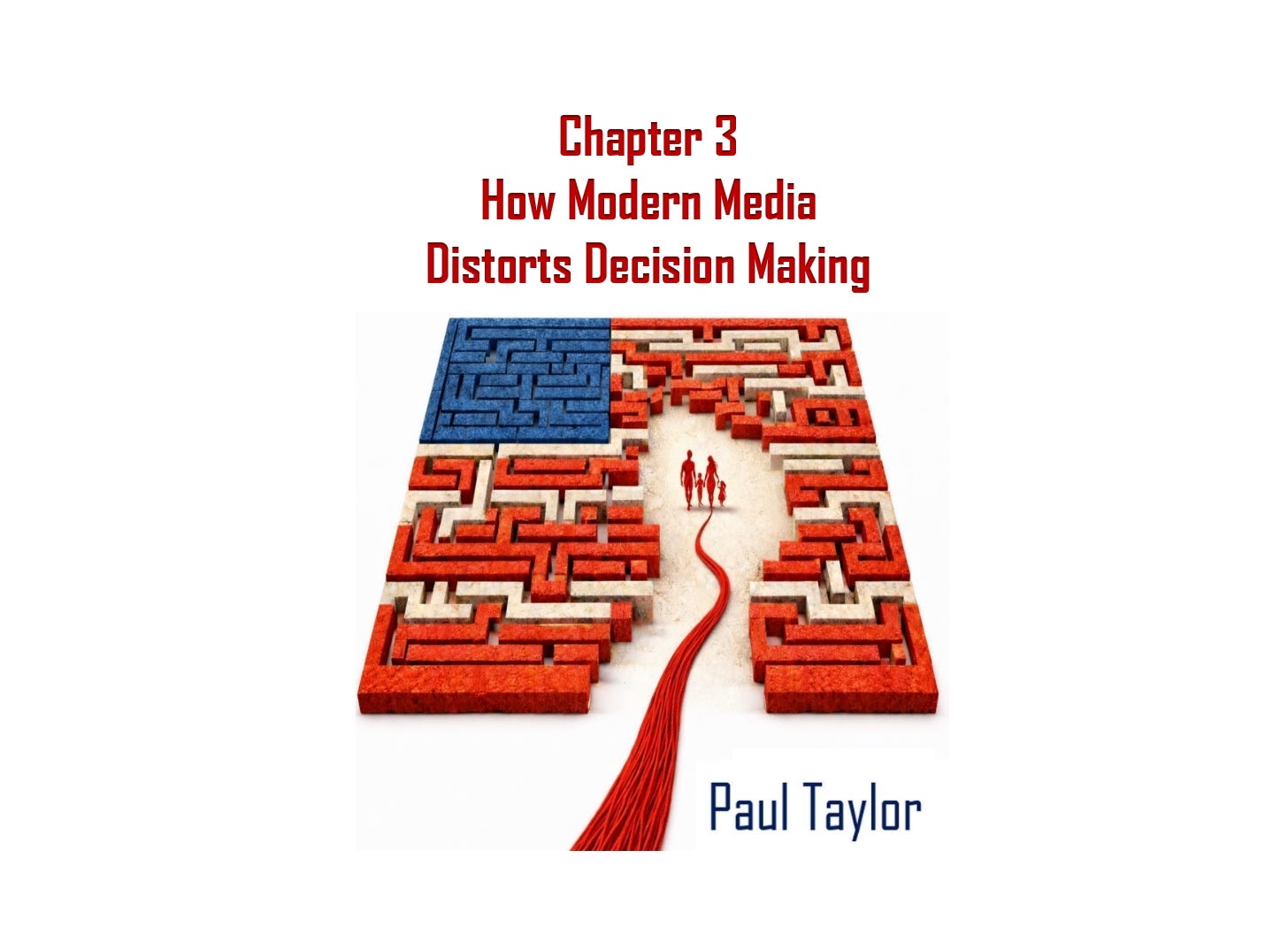
In Greek mythology, Daedalus is a supreme craftsman, inventor, engineer, and problem-solver, but one who often used his skill in ways that were too clever for his own good. His extraordinary intelligence often outpaced his moral judgment. So, for example, Daedalus designed the labyrinth that trapped the Minotaur, and the many children sacrificed to the monster, only to be imprisoned himself in the same labyrinth when he incurred the wrath of King Minos. In many ways, today’s social media amount to the same sort of entrapment by design.
So many Americans now have the world’s knowledge available to them through cell phones and the internet, but they don’t access that knowledge. Instead, they subject themselves to scrolling through endless snippets of social media and responding to a perpetual barrage of instant notifications. As we’ll see in this chapter, beyond fomenting the tribalism we’re already genetically susceptible to, social media has a tendency to both preoccupy our thoughts and displace other thoughts we might have. We check emails, social media, and text messages that are announced by sounds and vibrations jabbing us throughout the day, producing a sort of death by a thousand cuts. To what extent have these myriad pulls on our attention hurt our ability to think clearly, and to think in context?
For hundreds of years, long-form books have conveyed sustained arguments over hundreds of pages, providing the layers of analysis necessary to connect enough concepts such that reading them could be reasonably understood as “expanding knowledge.” But reading books, among both young people and adults, is declining significantly. A 2025 study based on the U.S. government’s Time Use Survey of 236,000 Americans, found that the proportion of people who read for pleasure has fallen dramatically since 2000: on average in 2003, 28 percent of Americans were reading, but by 2023 only 16 percent were. The researchers concluded, “The most concerning disparities were those that increased over time, with widening gaps between Black and White racial groups, levels of education and income …” A 2022 survey found that 52 percent of Americans hadn’t read a book in over a year, and one in 10 hadn’t read a book in over 10 years. Among younger people, baby boomers read more than double the number of books per year than millennials and those in Generation Z. Andreas Schleicher, director for education and skills at the Organisation for Economic Co-operation and Development, said in 2024 that “Thirty percent of Americans read at a level that you would expect from a 10-year-old child.”
As 2016 study by computer scientists at Columbia University found that 59 percent of people who share a link on social media don’t even read the underlying story, even while that sort of blind peer-to-peer sharing determines what news gets circulated, at the expense of news on everything else. As a reporter at the Washington Post wrote, “So your thoughtless retweets, and those of your friends, are actually shaping our shared political and cultural agendas.” Commenting on the same study, Jayson DeMers said “The circulation of headlines in this way leads to an echo chamber effect. Users are more likely to share headlines that adhere to their pre-existing conceptions, rather than challenging them.”
Considering that most people just read headlines, and not the articles themselves, it should be of concern that news media headlines aren’t even written by journalists; they’re written by separate departments whose job is to get people’s attention. Researchers found that “clickbait” headlines, especially those designed to trigger strong emotions, are widely used and can differ from the informational content of the articles themselves. Competitive online environments incentivize emotionally provocative headlines to drive engagement. Headline writers must capture a reader’s attention in milliseconds, and to do so they sacrifice accuracy for exaggeration, and it’s the exaggeration that ends up framing the article for the reader, if they even read the whole article.
Nicholas Carr, in his book The Shallows: What the Internet Is Doing to Our Brains, writes that the development of printing, and then the proliferation of printed books, allowed people to relay arguments and facts on an unprecedented scale, in a way that ultimately changed how people debated the issues of the day. Carr wrote:
The arguments in books became longer and clearer, as well as more complex and more challenging, as writers strived self-consciously to refine their ideas and their logic … The advances in book technology changed the personal experience of reading and writing. They also had social consequences … The literary mind, once confined to the cloisters of the monastery and the towers of the university had become the general mind … The words in books didn’t just strengthen people’s ability to think abstractly, they enriched people’s experience of the physical world, the world outside the books.
But today, in the internet age, Carr relays, “Dozens of studies by psychologists, neurobiologists, educators and Web designers point to the same conclusion: When we go online, we enter an environment that promotes cursory reading, hurried and distracted thinking, and superficial learning. It’s possible to think deeply while surfing the Net, just as it’s possible to think shallowly while reading a book, but that’s not the type of thinking the technology encourages and rewards.”
People used to read books not as a chore, but because it brings the sort of pleasure psychologists have come to call “flow,” a term coined by Mihaly Csikszentmihalyi. Flow is a mental state of complete absorption and energized focus, often called “being in the zone,” a place where a person feels so fully immersed that they lose track of time, enjoying the process itself. Johann Hari, in his book Stolen Focus: Why You Can’t Pay Attention – and How to Think Deeply Again, writes:
[O]ne of the simplest and most common forms of flow that people experience in their lives is reading a book— and, like other forms of flow, it is being choked off in our culture of constant distraction. I thought a lot about this. For many of us, reading a book is the deepest form of focus we experience— you dedicate many hours of your life, coolly, calmly, to one topic, and allow it to marinate in your mind. This is the medium through which most of the deepest advances in human thought over the past four hundred years have been figured out and explained. And that experience is now in free fall … When I was at Harvard conducting interviews, one professor told me that he struggled to get his students there to read even quite short books, and he increasingly offered them podcasts and YouTube clips they could watch instead. And that’s Harvard.
Flow involves a deep immersion in a sustained activity. But social media only provides a truncated and disjointed one. Hari cites the example of X, formerly known as Twitter:
I thought first of Twitter. What is that message? First: you shouldn’t focus on any one thing for long. The world can and should be understood in short, simple statements of 280 characters. Second: the world should be interpreted and confidently understood very quickly. Third: what matters most is whether people immediately agree with and applaud your short, simple, speedy statements. A successful statement is one that lots of people immediately applaud; an unsuccessful statement is one that people immediately ignore or condemn. When you tweet, before you say anything else, you are saying that at some level you agree with these three premises.[1]
As Hari explains:
[T]he messages implicit in these mediums— are wrong. Let’s think about Twitter. In fact, the world is complex. To reflect that honestly, you usually need to focus on one thing for a significant amount of time, and you need space to speak at length. Very few things worth saying can be explained in 280 characters. If your response to an idea is immediate, unless you have built up years of expertise on the broader topic, it’s most likely going to be shallow and uninteresting. Whether people immediately agree with you is no marker of whether what you are saying is true or right … Reality can only be understood sensibly by adopting the opposite messages to Twitter. The world is complex and requires steady focus to be understood; it needs to be thought about and comprehended slowly; and most important truths will be unpopular when they are first articulated.
Today, we receive information as small bits of lint that accumulate in our mental pockets but add nothing to the fabric of our being. In fact, social media was purposefully designed to discourage sustained thought, and act like blinders on a horse on a treadmill.
As Hari explains in Stolen Focus, Tristan Harris, a former Google engineer, figured out success was measured by the company in units of “engagement”: the amount of time spent on an app. The more engagement the better. At root, the longer people look at their phones, the more advertising they see, and most social media apps ultimately make their money through selling advertising. As Hari writes:
One day [Harris] would hear an engineer excitedly saying: “Why don’t we make it buzz your phone every time we get an email?” Everyone would be thrilled— and a few weeks later, all over the world, phones began to buzz in pockets, and more people found themselves looking at Gmail more times a day … Aza [Raskin] designed something that distinctly changed how the web works. It’s called “infinite scroll.” Older readers will remember that it used to be that the internet was divided into pages, and when you got to the bottom of one page, you had to decide to click a button to get to the next page. It was an active choice. It gave you a moment to pause and ask: Do I want to carry on looking at this? Aza designed the code that means you don’t have to ask that question anymore … You scroll down through it, flicking your finger— and when you get to the bottom, it will automatically load another chunk for you to flick through … and another, and another, forever … One day, James Williams— the former Google strategist I met— addressed an audience of hundreds of leading tech designers and asked them a simple question: “How many of you want to live in the world you are designing?” There was a silence in the room. People looked around them. Nobody put up their hand.
Nobody put up their hand because what had been designed was a labyrinth from which people couldn’t escape. And the Minotaur inside was sapping our strength before eating us alive.
It would be one thing if the twists and turns of the maze were random, but they’re not. They’re actually designed to lead us further and further into the maze, until we can’t see the way out. The algorithms are programmed to direct your attention to specific things that it predicts will keep you hooked to your screen. Hari, returning to his interview with Tristan Harris, writes, “[T]hese sites learn— as Tristan put it— how to ‘frack’ you. These sites get to know what makes you tick, in very specific ways— they learn what you like to look at, what excites you, what angers you, what enrages you. They learn your personal triggers— what, specifically, will distract you.”
Even worse, the algorithms discovered a glitch in the matrix of human nature embedded in our psychology by evolution. As Hari writes:
Imagine two Facebook feeds. One is full of updates, news, and videos that make you feel calm and happy. The other is full of updates, news, and videos that make you feel angry and outraged. Which one does the algorithm select? The algorithm is neutral about the question of whether it wants you to be calm or angry. That’s not its concern. It only cares about one thing: Will you keep scrolling? Unfortunately, there’s a quirk of human behavior. On average, we will stare at something negative and outrageous for a lot longer than we will stare at something positive and calm … This has been known about in psychology for years and is based on a broad body of evidence. It’s called “negativity bias.” … If it’s more enraging, it’s more engaging.
As Arthur Brooks and Oprah Winfrey write in Build the Life You Want: The Art and Science of Getting Happier:
Mother Nature gave you … negativity bias: a tendency to focus on negative information far more than positive information. The reason is simple: compliments are nice, but nothing happens when we ignore them. But we ignore criticism at our peril. A couple thousand years ago, that could mean being cast out of the tribe. Today it can mean losing your job or strife with a friend. So we naturally focus on negative information.
When these algorithms come to move so many people to anger, they come to move the culture. As Tristan told Hari, it “turns hate into a habit.”
And what happens when more people feel more anxiety? Their bodies enter threat mode, which increases the flow of the stress hormone cortisol, which evolved to block our more logical modes of thinking in favor of triggering a rushed response,[2] like immediately fleeing a hungry lion without wasting time thinking about it. When children feel anxiety, they often cry, and while they’re crying it’s impossible to reason with them, as they’ve temporarily lost the ability to reason. In such situations, parents need to wait a few moments, so a child can calm down and lower their cortisol levels. Only then can logical reasoning resume. Social media is designed to trigger anxiety in adults and, worse, encourage them to respond online at the very moment they’re least capable of calmly reasoning. As Hari writes, “Scientists have been proving in experiments for years that anger itself screws with your ability to pay attention. They have discovered that if I make you angry, you will pay less attention to the quality of arguments around you, and you will show ‘decreased depth of processing’ — that is, you will think in a shallower, less attentive way.” Indeed, researchers have found that anger actually makes people more susceptible to misinformation than people in a more neutral emotional state. The same researchers found that study participants who were angry tended to be more confident in the accuracy of their memories, but among those participants increased confidence was actually associated with decreased accuracy. In contrast, among those in a neutral emotional state (the more Stoic among them), increased confidence was associated with increased accuracy.
When what you thought was a mountain lion along your hiking trail turns out to be another hiker, you at least start to calm down. But social media aggravates the situation because people who post there don’t actually meet face-to-face with anyone. Researchers have found that when people hear a human voice articulating contrary political views, they’re less likely to demonize those articulating them because hearing a voice humanizes a person. But that’s not the social media norm, where people vent at glowing electrons instead of human faces and make political polarization worse.
And the “people” on social media may not exist at all. As Catherine Price writes in her book The Power of Fun: How to Feel Alive Again:
What’s particularly crazy about our obsession with external validation is that many of the people we seek affirmation from online aren’t actually real. There are millions of fake accounts on social media platforms—it’s a constant struggle for social media companies to identify and purge these accounts—so it’s quite possible that some of the “likes” and follows that you’re interrupting your life to earn are actually coming from bots, not people.[3]
And as it turns out, studies show that the use of social media like Facebook -- including status updates, link click counts, and “like” counts -- is negatively associated with mental health.
Indeed, lots of evidence shows users of social media are as unhappy as losing gamblers, which is not surprising considering social media operates like a casino.
As Will Storr writes in The Status Game:
Social media is a slot machine for status. This is what makes it so obsessively compelling … We await replies, likes or upvotes and, just as a gambler never knows how the slot machine will pay out, we don’t know what reward we’ll receive for our contribution. Will we go up? Will we go down? … This variation creates compulsion. We just want to keep playing, again and again, to see what we’ll get.
And it’s not just a row of three thumbs up that we’re looking for in the slot machine. Even the more mundane aspects of communication today have the feel of pulling a lever. As Tristan Harris has said, “When we pull our phone out of our pocket, we’re playing a slot machine to see what notifications we have received. When we swipe down our finger to scroll the Instagram feed, we’re playing a slot machine to see what photo comes next. When we ‘Pull to Refresh’ our email, we’re playing a slot machine to see what email we got. When we swipe faces on dating apps like Tinder, we’re playing a slot machine to see if we got a match.”
In 2012, psychologist Larry Rosen described heavy social media users as exhibiting symptoms similar to those displayed in psychiatric conditions like obsessive-compulsive disorder (OCD) and attention-deficit/hyperactivity disorder (ADHD). And sure enough, entering college students have increasingly reported mental health issues. As the Wall Street Journal reported in 2018:
As many as one in four students at some elite U.S. colleges are now classified as disabled, largely because of mental-health issues such as depression or anxiety, entitling them to a widening array of special accommodations like longer time to take exams … The rise in disability notes for mental-health issues has led to a surge in the number of students who take their exams in low-distraction testing centers, are allowed to get up and walk around during class or bring a comfort animal to school, among other measures … Among the nation’s most elite institutions, those with the highest percentage of disabled students were Stanford (14%), Brown (12%), Yale (11%) and Columbia University (8%).
By 2025, at Stanford, nearly 40 percent of undergraduates were registered as disabled, as were more than 20 percent at Harvard and Brown, with the increases driven by more students receiving diagnoses for conditions such as ADHD, anxiety, and depression.
And whereas in the past younger people became happier when they became adults, today younger people are becoming less happy when they become adults, as their social media habits follow them into adulthood.
So far, we’ve examined how evolution left us with genetic tendencies to wrap ourselves in the warm blanket of tribal thinking, and to resist the sometimes stingingly cold truths of the wider world. We’ve also seen how the advent of social media wrapped that blanket tighter and, in this chapter, how social media has pulled the blanket over our heads. Is there a way we can train our minds to stop hitting the snooze button and throw off that blanket so we can get out of bed and start facing some uncomfortable things -- and become the more resilient for it? In the next chapter, we’ll follow our threads back to the ancient Greeks, who first developed the techniques of self-control and self-critique.
[NOTE TO READERS: This is the last draft chapter that will be available for free. Starting next week, this Substack will move to subscriber-only, so if you’d like to receive more of these draft book chapters, please consider clicking the “Subscribe” button at the bottom of this page and becoming a paid subscriber.]
Further Reading
Nicholas Carr, in his book The Shallows: What the Internet Is Doing to Our Brains
Johann Hari, in his book Stolen Focus: Why You Can’t Pay Attention – and How to Think Deeply Again
[1] Hari adds: “How about Facebook? What’s the message in that medium? It seems to be first: your life exists to be displayed to other people, and you should be aiming every day to show your friends edited highlights of your life. Second: what matters is whether people immediately like these edited and carefully selected highlights that you spend your life crafting. Third: somebody is your ‘friend’ if you regularly look at their edited highlight reels, and they look at yours — this is what friendship means.”
[2] As Richard Layard and Jan-Emmanuel De Neve write in Wellbeing: Science and Policy:
The body has a mechanism that responds to stress in a similar way whether the stress is physical or mental. This is sometimes called the “fight or flight” response … [T]he ‘autonomic nervous system’ … is largely outside our conscious control and regulates the workings of all our internal organs. The autonomic system has two main branches: the sympathetic and the para-sympathetic. It is the sympathetic nervous system that initiates the fight or flight response. It immediately instructs the adrenal gland to produce what Britons call adrenaline and Americans call epinephrine. This is a hormone (Greek for messenger) that enters the bloodstream and galvanises the whole body for action. It also mobilises the immune system to produce pro-inflammatory cytokines in case they are needed to handle possible infections … At the same time, a second hormone is produced in another part of the adrenal gland: cortisol. A message goes from the brain’s hypothalamus to the pituitary gland to the adrenal gland, which releases cortisol into the bloodstream, and this then stimulates the muscles by releasing their store of glucose. The stress response is totally functional when the stress is brief. But when the stress is persistent, it can lead to over-activity of the immune system (especially of C-reactive protein and IL6) and to persistent inflammation around the body, which eventually reduces life expectancy.
[3] On the flip-side, Price adds that it’s also likely that some of the social media “influencers” people look up to because of their huge followings have paid for those increases in “followers.” In 2018, The New York Times found it was possible to buy 25,000 Twitter followers from a company for $225, about a penny each. At the time, that company had “more than 200,000 customers, including reality television stars, professional athletes, comedians, TED speakers, pastors and models.”